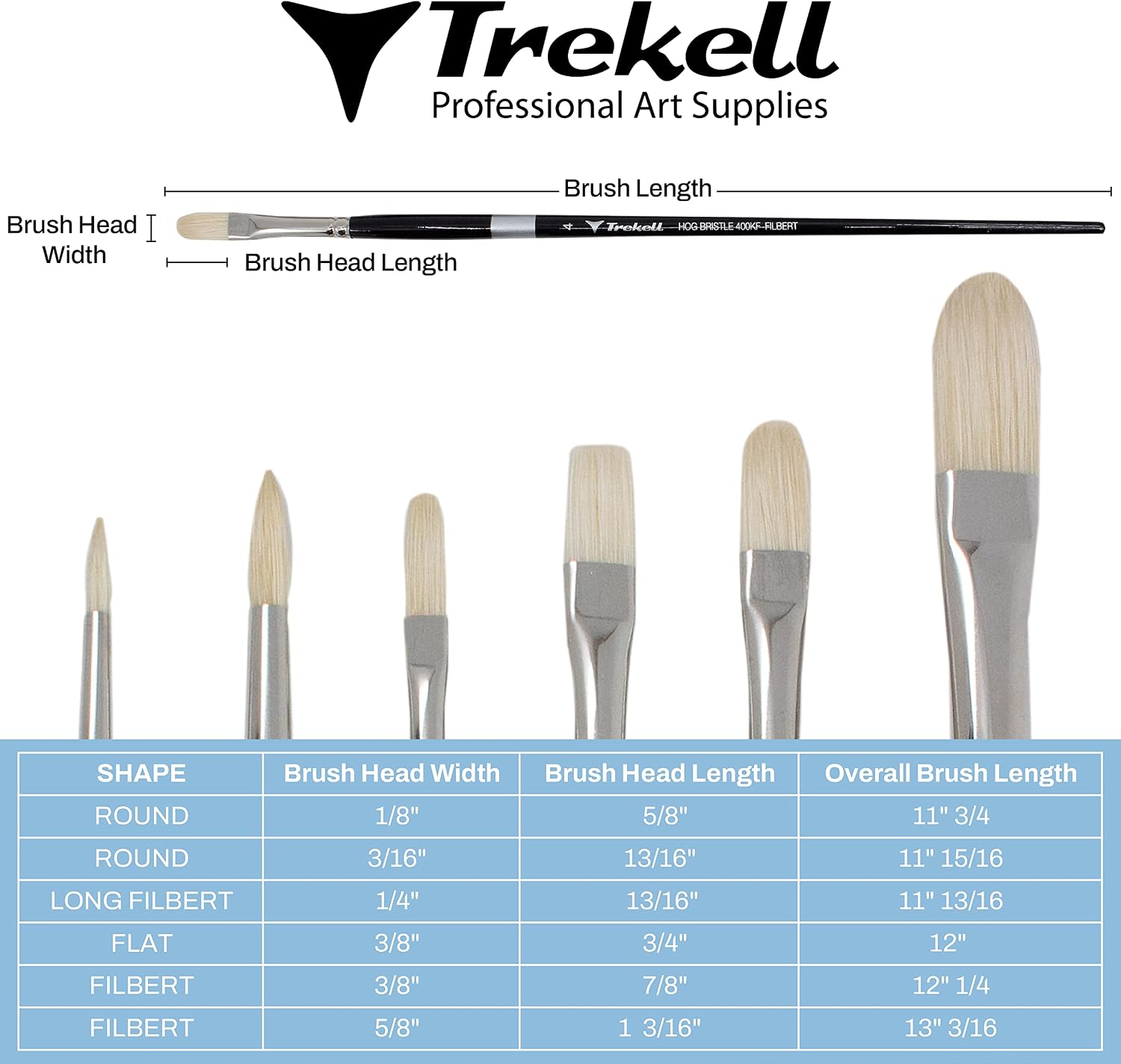
If you’ve ever ordered a “professional hog-bristle set” online and received something that felt more like a bundle of stiff plastic wires than a painting tool, you already understand why this buying decision is harder than it looks. Hog bristle — meaning hair harvested from domestic pigs — is the traditional choice for oil painting because each individual strand has a naturally split tip called a flag that holds paint and releases it gradually onto the canvas. That flag is what separates a real working brush from a cheap imitation. A set of genuine, flag-intact hog-bristle brushes gives you the scrubbing power and paint-loading capacity that oil painting demands; a set of low-grade bristle (or synthetic bristle marketed as natural) fights you at every stroke. This guide explains how to evaluate a hog-bristle set before you commit — what the specs actually mean, which trade-offs are worth accepting at which price points, and what the market looks like as of mid-2026.
What “Quality” Actually Means in Hog Bristle
The single most important structural feature in a hog-bristle brush is the flag — that forked, frayed tip on each natural filament. Flags increase the surface area that contacts the canvas and create the characteristic broken, textured stroke oil painters rely on. Jackson’s Art Supplies’ overview of brush hair types for oil painting notes that genuine Chungking hog bristle (sourced from China’s Sichuan province, where colder winters produce thicker, stiffer hair) retains its flags through the manufacturing process when treated correctly, while lower-grade bristle is often boiled, chemically processed, or simply too fine to flag meaningfully.
Here’s the first diagnostic question to ask before you buy: does the product listing name the bristle origin? Any set marketed with language like “selected Chungking hog” or “interlocked pure bristle” is signaling that the manufacturer sourced and sorted by grade. A listing that says only “natural bristle” or “boar hair” — especially at a sub-$30 price for a twelve-brush set — is almost certainly working with mixed or commodity-grade stock.
Interlocking is the second term worth understanding. Quality hog bristle is interlocked — meaning filaments within the bundle curve inward toward the center of the brush head, creating a natural spring and resistance. Artists Network’s guide to oil painting brush selection explains that interlocked bristle maintains its shape under pressure, springs back after each stroke, and distributes paint more evenly than a limp or straight-set bundle. You can assess this at point of purchase: press the bristle head lightly against a flat surface. A properly interlocked brush resists compression and returns to shape. A low-grade brush collapses flat and stays there.
Reading the Ferrule and Handle Before You Paint
The bristle gets most of the attention, but the ferrule — the metal collar that joins the hair bundle to the handle — is where many otherwise decent sets fall apart, sometimes literally. Ferrules on quality oil brushes are crimped (mechanically pressed onto the handle), seamless where possible, and made from nickel-plated brass or aluminum. Escoda’s published construction documentation for their Versatil and Clasico lines specifies double-crimped ferrules as standard; that second crimp matters because oil painting involves significant lateral stress that single-crimp ferrules can’t sustain over time.
What to look for in listings and product imagery:
- Seamless vs. seamed ferrule. A seam running the length of the ferrule is a manufacturing shortcut and a corrosion point. Premium sets avoid it.
- Ferrule-to-handle fit. If product reviews mention “loosening after a few uses” or “handle wobble,” that’s a ferrule adhesion failure — a manufacturing defect that no amount of bristle quality overcomes.
- Handle length. Long handles (typically 12–14 inches) are standard for easel work because they encourage painters to stand back and read the full canvas. Short-handle versions exist for detail work or plein air travel, but a set marketed as “professional” with uniformly short handles should raise questions about its intended use case.
Rosemary & Co’s published specifications for their Eclipse and Ivory lines describe handle lacquer as a deliberate durability choice that resists oil-paint solvent exposure — a detail worth noting because handles on cheaper sets will often soften, blister, or delaminate when they contact mineral spirits or odorless turpentine repeatedly.
Set Composition: What Shapes You Actually Need
A twelve-brush set sounds more complete than a four-brush set, but set composition matters more than count. Most working oil painters, as covered in The Artist’s Magazine’s brush basics overview, build their working kit around a core of four to six shapes and reach for specialty shapes only occasionally. Here’s the practical breakdown:
The core shapes:
- Flat — a square-tipped brush that excels at block-ins, large passages, and controlled edge work. The workhorse of most oil palettes.
- Bright — a shorter flat with stiffer action; good for impasto and thick, loaded strokes.
- Filbert — an oval-tipped brush that produces soft, almond-shaped strokes; the most versatile shape for figurative and landscape work.
- Round — tapers to a point; used for line work and detail but less central to oil painting than to watercolor.
- Fan — for blending; useful but not essential for beginners.
A well-composed set for an intermediate painter includes flats and filberts across three or four sizes (roughly sizes 4, 6, 8, and 10 in standard numbering), one or two brights, and optionally a round or fan. A twelve-brush set that achieves this deserves serious consideration. A twelve-brush set that duplicates the same shape in slightly different sizes while skipping filberts entirely — a real pattern in budget sets — is padding for perceived value.
By the numbers — what mid-2026 pricing looks like:
| Tier | Price Range | What You’re Buying |
|---|---|---|
| Entry / student | $18–$45 per set | Mixed-grade bristle, seamed ferrules, limited shape selection |
| Mid-range prosumer | $60–$150 per set | Chungking bristle, better ferrule work, broader shape variety |
| Professional (Rosemary, Escoda, Blick Master) | $150–$400+ per set | Interlocked select bristle, crimped ferrules, shape-specific engineering |
Price swings of 15–25% are common across retailers in this category, particularly on prosumer sets — the same set from Rosemary & Co or Escoda can vary meaningfully between direct purchase and third-party fulfillment. It’s worth checking the manufacturer’s direct price before assuming a “sale” represents genuine savings.
How to Evaluate a Set You Can’t Touch Before Buying
Most intermediate painters are buying online, which means you’re working from images, descriptions, and aggregated reviewer experience. Here’s a repeatable evaluation framework:
1. Find the bristle specification language. “Pure Chungking hog,” “selected bristle,” or “interlocked natural bristle” signals intentional sourcing. “Natural fiber,” “boar bristle,” or nothing at all is a yellow flag. The more specific the language, the more confidence the manufacturer has in what they’re selling.
2. Check for shape diversity in the set. Count the unique shapes, not the brush count. A set heavy on rounds and fans but light on flats and filberts is shaped for a general craft buyer, not an oil painter.
3. Read the one-star reviews selectively. One-star reviews that mention shedding within the first session, ferrule loosening, or bristle that refuses to hold a load after cleaning are structural failure signals — not preference issues. Aggregate these patterns across reviews rather than weighting any single complaint. Owners across multiple review aggregators consistently flag shedding as the first sign of poor ferrule adhesion in budget sets.
4. Look for handle material specifics. “Lacquered hardwood” with a named wood species (beech, birch, hornbeam) outperforms “painted wood” or unspecified “wooden handle.” The lacquer description matters specifically because oil painters work with solvents.
5. Check whether the brand publishes care guidance. Brands confident in their bristle quality publish brush-care instructions because they expect their customers to use these brushes for years. A listing that offers no care documentation is optimized for replacement, not longevity.
The Trade-offs Nobody Mentions
Every set is a compromise. Here’s where the real decision points live:
Price vs. flagging integrity. Below roughly $45 for a set, flagging is almost always compromised — either by over-processing or by sourcing fine-diameter bristle that doesn’t flag naturally. The jump from entry to mid-range is where you feel the difference most acutely. The jump from mid-range to professional is more nuanced and matters most to painters doing sustained, demanding work.
Set convenience vs. shape optimization. Pre-built sets are priced attractively but include shapes you may never reach for. Some painters find more value building a five-brush kit from a brand’s individual offerings than accepting a twelve-brush set weighted toward shapes they don’t use. This is a legitimate strategy, especially if you have clarity on your primary painting style.
Natural vs. synthetic hog alternatives. Synthetic brushes (nylon and PBT filament) have improved significantly in the past decade, and several manufacturers now produce synthetic rounds that approximate hog performance for thinned, fluid oil applications. The Artist’s Magazine has noted that synthetic sets perform comparably to entry-level hog sets for underpainting and initial lay-ins. But for thick, textured, fully loaded impasto work, reviewers and working painters consistently return to natural hog — the flag’s behavior under load isn’t reliably replicated by synthetic filament yet.
Chungking vs. other bristle origins. Chungking remains the benchmark, but supply chain documentation from mid-range manufacturers is rarely detailed enough to verify origin claims. Established brands with long reputations — Rosemary & Co, Escoda, Winsor & Newton’s Monarch hog line — have supply relationships they’re commercially motivated to maintain. Lesser-known brands making Chungking claims with no supporting documentation are a harder call.
If X, Then Y — The Decision Rule
If you’re painting regularly (several sessions per week) and working in any technique that involves loaded brushes and textured application — buy at the mid-range or above. The $60–$150 range from established brands is where flagging integrity and ferrule construction cross a threshold that actually affects your daily painting experience. Start with four to six brushes covering flats, filberts, and brights across sizes 4 through 10.
If you’re painting occasionally, working through technique development, or not yet sure how your style will settle — an entry-level set is a reasonable starting position, but treat it as a one-to-two-year tool rather than a long-term investment. Budget accordingly, and plan to upgrade selectively as your practice clarifies which shapes you actually reach for.
If you’re working at the professional level and considering a full set replacement — buy directly from the manufacturer where possible (Rosemary & Co and Escoda both sell direct), verify the set composition against your actual shape preferences rather than defaulting to a pre-packaged twelve-brush assortment, and factor in the 15–25% price variability across the retail landscape before committing.
The brush doesn’t make the painting. But a brush that holds its load, springs back under your hand, and survives a season of honest use stops being a variable and starts being a tool. That’s what you’re buying when you read a set carefully before you buy it.