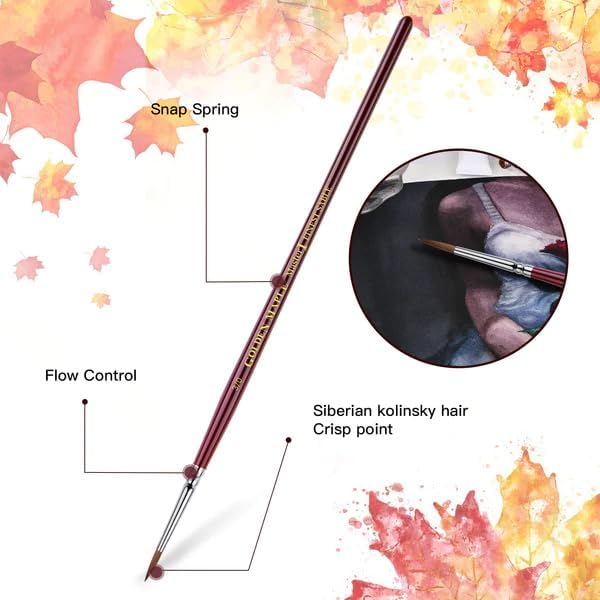
If you’ve recently moved from cheap synthetic brushes to something better for painting miniatures — the small, highly detailed figurines used in tabletop games and model collections — you’ve probably heard the term kolinsky sable thrown around constantly. Kolinsky sable refers to a specific type of natural animal hair, taken from the tail of the Siberian kolinsky (a weasel-like animal), and it’s considered the gold standard material for fine-detail brushwork. The hair has a unique combination of properties: it holds a lot of paint, releases it at a controlled rate, and — most importantly for miniature painters — snaps back to a sharp, precise point after every stroke. That last quality is called tip retention, and once you understand it, you’ll realize it’s the single variable that separates a brush worth $25 from one worth $8. This guide will walk you through what tip retention actually is, how to evaluate it before you commit to a purchase, and how to weigh the real trade-offs between the brands miniature painters talk about most.
| EDITOR'S PICKKolinsky Sable Miniature Paint… | Mid-tierKolinsky Sable Miniature Waterc… | Budget pickKolinsky Sable Miniature Paint… | |
|---|---|---|---|
| Tip size range | — | #00000, #00, #0, #1, #3 | 3/0, 4/0, 5/0 |
| Quantity | 7 pcs | 5 pcs | 6 pcs |
| Brush types | Detail + drybrush | Round only | Detail only |
| Price | $37.99 | $27.19 | $20.65 |
| See on Amazon → | See on Amazon → | See on Amazon → |
What Tip Retention Actually Means (and Why Miniature Painting Punishes Poor Retention Hard)
Tip retention is a brush’s ability to return to a fine, consistent point after being loaded with paint and dragged across a surface. For watercolor painters working on full-scale paper, a brush with mediocre retention is annoying. For a miniature painter putting a highlight on a 28mm face — a surface roughly the size of your pinky fingernail — mediocre retention is genuinely unusable. The margin for error is almost zero.
Here’s what’s happening structurally: the ferrule (the metal sleeve that clamps the hairs together at the base) compresses the hair bundle into a tight cone. Quality kolinsky hairs have a natural taper — they’re thicker at the root end and come to a fine natural point at the tip. When you press the brush to a surface and then lift, the hair’s internal memory and the mechanical pressure from the ferrule cooperate to return the bundle to that cone shape. The “snap” you feel is the elastic rebound of the hair fiber.
Cheaper sable substitutes — squirrel, pony, or lower-grade weasel hair blends often labeled vaguely as “red sable” — have softer, less-tapered fibers. They load paint fine. They release it fine. But after a few strokes they splay and droop, and you spend as much time reshaping the tip as you do actually painting. As Jackson’s Art Supplies notes in their sable brush guide, the distinguishing quality of genuine kolinsky is the combination of natural taper, surface texture (which creates paint-holding capacity called belly), and stiffness relative to hair diameter — a trio that synthetic fibers still approximate rather than replicate.
The Numbers That Matter Before You Buy
When miniature painters discuss brushes, the conversation almost always circles back to a few shared reference points. Here’s a quick orientation to the pricing landscape as of mid-2026:
| Brush / Line | Size Range Discussed | Approximate Price Per Brush |
|---|---|---|
| Winsor & Newton Series 7 | Size 000 – 2 | $22 – $55 |
| Da Vinci Maestro Series 35 | Size 000 – 2 | $18 – $45 |
| Raphael 8404 | Size 000 – 2 | $14 – $32 |
| Rosemary & Co. Series 33 | Size 000 – 2 | $10 – $28 |
Prices have trended 10–15% higher since early 2025, reflecting ongoing pressure on kolinsky supply chains tied to CITES (the Convention on International Trade in Endangered Species) export documentation requirements from Russia, which remains the primary source of kolinsky pelts. Several retailers have flagged intermittent stock gaps on the smallest sizes (000, 0) specifically — worth monitoring if you need multiples.
Brand-by-Brand Trade-offs: Honest Notes for the Miniature Painter
Winsor & Newton Series 7
The Series 7 is the benchmark almost everyone uses — not because it’s always the best for every painter, but because it’s the most documented. Artists Network’s coverage of premium sable brushes consistently returns to the Series 7 as the clearest example of what genuine kolinsky performance looks like at scale. The tip on a Series 7 size 1 is frequently described by long-term users as almost architectural — it holds a point through an extended painting session without prompting, even as the belly softens slightly with heat from your hand.
The honest trade-off: you’re paying partly for the brand’s quality control (which is rigorous) and partly for the brand’s name. Owners who’ve worked through multiple Series 7 brushes report occasional duds — a size 0 with an off-center tip, or hairs that splay earlier than expected. Winsor & Newton’s own manufacturing documentation acknowledges that natural-hair products involve inherent variability. At $30–$55 for a single miniature-scale brush, that variability stings.
The other issue is sizing. W&N rounds tend to run slightly larger than equivalent sizes from other makers. A Series 7 size 1 carries more paint than many painters expect — which is wonderful for wet blending, but potentially unwieldy for extreme fine-line work where a size 0 or 000 is more useful. If you’re doing face detail and freehand, size down one from your instinct.
Da Vinci Maestro Series 35
Da Vinci’s Maestro line is the counter-argument to “just buy Series 7.” Manufactured in Germany with kolinsky sourced through European suppliers, the Maestro 35 has developed a loyal following among miniature painters specifically because the point behavior is different in a useful way: slightly less belly than the Series 7, but often sharper and more consistent in the very fine sizes. Artists who paint competition-level miniatures — work where a single misplaced stroke on a 1mm pupil matters — tend to prefer the Maestro 35 in sizes 000 and 0 for exactly this reason.
Price-per-performance math favors the Maestro 35 for most intermediate painters. You’re getting 85–90% of Series 7 tip performance at roughly 75–80% of the price, and Da Vinci’s quality control reviews across aggregated buyer feedback suggest slightly fewer dead-on-arrival tips. The trade-off is less retail availability — you’re more likely to be ordering online than finding it at a local art store, and return-and-replace becomes more logistically complicated if you get a dud.
Raphael 8404
The Raphael 8404 is the value case. French-manufactured, using kolinsky sourced from a separate supply chain than the German and UK makers, the 8404 has been a staple recommendation in miniature painting communities for over a decade. The tip retention isn’t quite at Series 7 levels — owners consistently note that the 8404 shows its age faster, with splaying becoming noticeable after heavier use — but “faster” is relative. Many painters report 6–12 months of solid service from a properly maintained 8404, which is a reasonable lifespan at its price.
Where the 8404 earns its place is as a second-chair brush. Use a Maestro or Series 7 for the highest-stakes detail work, and keep a Raphael loaded with a commonly used mid-tone for base-coating or layering where the tip precision matters less. The cost savings let you replace it without grief when it wears.
Rosemary & Co. Series 33
Rosemary & Co. is a UK-based manufacturer with a devoted following among budget-conscious painters who don’t want to compromise on hair quality. Their Series 33 uses genuine kolinsky and prices it at a point that makes stocking multiple sizes accessible. The caveat, noted across long-run reviews, is that belly is smaller and tip snap is softer than W&N or Da Vinci. For miniature work, this matters most in wet-blending techniques where you want the brush to carry a larger paint load and release it smoothly — the Series 33 is less suited to this than the Maestro or Series 7.
For dry detail work — stippling, edge highlights, fine lines applied with a drier brush — the Series 33 performs above its price. It’s also the most easily replaced, which lowers the psychological cost of actually using the brush hard rather than babying it.
How to Evaluate Tip Retention Before You Paint a Single Stroke
Most art supply retailers — and some online vendors — will let you wet a display brush and test its point. If you have that option, here’s what to look for:
The snap test: Load the brush lightly, press the belly gently against the back of your hand to splay the hairs, then lift. A quality kolinsky should recover its point in one motion, without stray hairs. Any persistent splaying or bent tip hairs is a warning sign.
The gravity test: Hold the brush horizontally, tip pointing away from you. The tip should hold its cone shape under its own weight. A brush that droops or opens sideways when horizontal will do the same during a painting stroke.
The light test: Under normal light, look at the tip head-on. The convergence should be symmetrical — hairs meeting at a single apex rather than forming a small fan or a split-point. Off-center ferrule crimping is the usual culprit for asymmetrical tips, and it’s a manufacturing defect, not wear.
If you’re buying online without a test opportunity, the aggregated buyer signal to weight most heavily is consistency reports — not peak performance claims. One reviewer saying a brush has “the sharpest tip I’ve ever seen” tells you less than twenty reviewers saying “every brush I’ve ordered from this line has come with a reliable point.”
The Decision Rule: If X, Then Y
Here’s the honest framework for where to put your money:
If you paint competition or display miniatures and tip failure mid-session is unacceptable: Start with Da Vinci Maestro Series 35 in sizes 0 and 1. Use the cost difference from skipping the Series 7 to buy a backup of each size. Upgrade to Series 7 only if the Maestro’s belly proves insufficient for your wet-blending style.
If you’re an intermediate painter building your first serious kit: Buy a single Winsor & Newton Series 7 in size 1 as your benchmark — you need to know what “correct” tip retention feels like before you can evaluate alternatives. Then fill out the rest of your size range with Raphael 8404 or Rosemary & Co. Series 33. This gives you a reference point and a working kit without spending $150+ to brush-up a full size set.
If you paint regularly but not at competition level and care more about longevity than peak performance: The Da Vinci Maestro 35 at sizes 0 and 1 is the clearest value recommendation in mid-2026’s market. It performs consistently, replaces affordably, and its point behavior rewards the kind of patient, controlled stroke technique that intermediate painters are usually actively developing.
If you’re still not sure what’s wearing out your current brushes: Before spending on kolinsky, rule out technique and maintenance issues. Paint dried in the ferrule is the single most common cause of premature splay, and it happens to expensive kolinsky just as fast as cheap synthetics. The Artist’s Magazine’s brush care coverage makes the point that most “brush failure” reported by intermediate painters is ferrule contamination, not hair quality degradation. A $12 Raphael maintained well will outlast a $45 Series 7 abused with dried acrylic.
Brand name is a useful shorthand for quality control — not a substitute for understanding what you’re buying. Tip retention is the variable that actually determines whether a miniature painting session goes cleanly or frustratingly. Once you can feel the difference, you’ll know exactly which tier of brush your work actually needs.