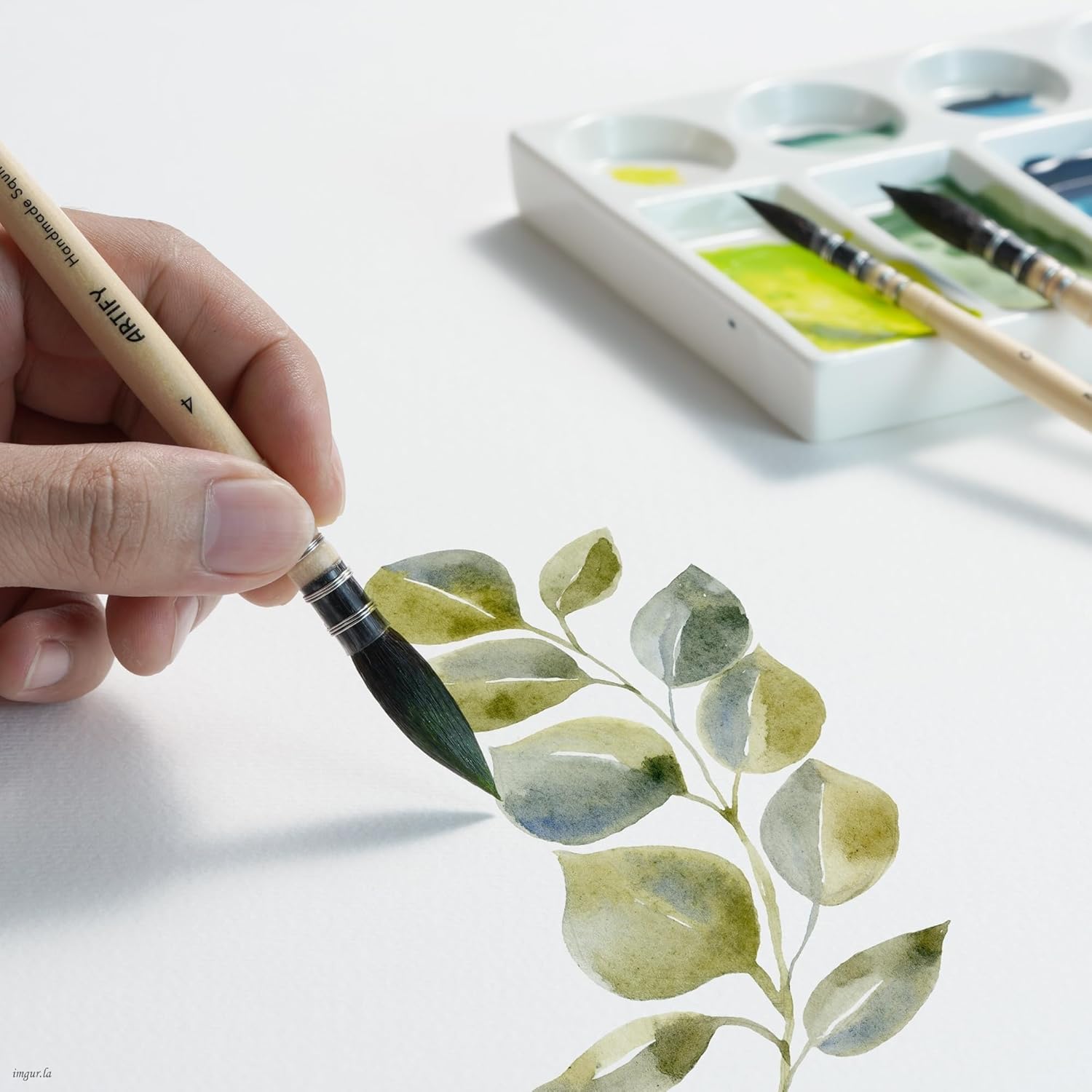
If you’ve spent any time around watercolor supplies, you’ve probably heard that kolinsky sable is the gold standard brush hair — the one every serious painter is supposed to want. And that reputation is largely earned: kolinsky sable (hair from the tail of the Siberian kolinsky weasel) holds a remarkable amount of water, snaps back to a fine point, and gives you precise control over a single stroke. But here’s the thing nobody tells beginners early enough — kolinsky sable is engineered for detail and precision, and a huge portion of what watercolorists actually need in a painting session is the opposite of that. Large, fluid washes of color across sky, water, and background? Wet-into-wet blooms where pigment floats freely in a pool of water? Soft, diffuse edges that bleed naturally? For those tasks, squirrel and goat hair brushes don’t just compete with kolinsky — they routinely outperform it, at a much lower price per brush. This guide is about understanding that tradeoff clearly enough to stop buying the wrong tool for the job.
| EDITOR'S PICK[ARTEGRIA Watercolor Brush Set](https://www.amazon.com/dp/B08FBDKG5K?tag=greenflower20-20) | Mid-tierWatercolor Brushes Professional | Budget pick[Transon 8pcs Round Watercolor P…](https://www.amazon.com/dp/B0C7C2J2XF?tag=greenflower20-20) | |
|---|---|---|---|
| Bristle type | Synthetic squirrel | Synthetic squirrel | Goat |
| Brush count | 10 | 10 | 8 |
| Shapes included | Pointed rounds, flats, dagger, oval wash | Flat, round pointed, dagger, cat's tongue, oval wash | Round only |
| Price | $19.95 | $19.26 | $12.99 |
| See on Amazon → | See on Amazon → | See on Amazon → |
What Squirrel and Goat Hair Actually Do Differently
The functional difference comes down to two properties that brush makers care about a lot: water capacity and snap.
Water capacity is how much liquid a brush belly (the widest part of the hair bundle) can hold before it needs to be reloaded. Snap is how quickly and completely the hairs spring back to their original shape after a stroke — what painters mean when they talk about a brush “returning to a point.”
Kolinsky sable has exceptional snap and a good belly, which is why it handles a detailed rigger stroke and a mid-sized wash equally well. It’s a generalist that excels at precision.
Squirrel hair is almost the opposite. It has virtually no snap — press it to a surface and the hairs spread and stay spread for a moment — but it holds a genuinely staggering amount of water relative to its size. A large squirrel mop (a round, dome-shaped wash brush usually sold in sizes ranging from small to very large) can carry enough pigment to cover a full half-sheet of watercolor paper in two or three unhurried strokes. That fluid delivery is the whole point. Painters who work wet-into-wet — loading a wet wash onto already-wet paper so colors bloom and merge — report that squirrel mops create softer, more naturalistic edges than sable because the water releases more freely and evenly. Jacksons Art Supplies’ watercolour brush guide notes that squirrel hair’s softness and high water retention make it particularly valued for large washes and atmospheric effects where control is less desirable than flow.
Goat hair occupies a middle zone. It’s coarser than squirrel and slightly stiffer, with better snap than squirrel but nowhere near kolinsky’s resilience. Goat hair is most common in hake brushes — flat, wide, Asian-style wash brushes used for broad strokes and background wetting — and in large mop forms. It’s the workhorse of the two alternatives: a bit less luxurious to load, but tough enough for repeated use on rougher paper textures. Artists Network’s brush guide describes goat-hair hake brushes as go-to tools for wetting large paper areas before applying wet-into-wet layers.
The Case Against Using Kolinsky for Everything
Here’s the math that shapes the buying decision:
By the numbers — May 2026 approximate price ranges:
- Winsor & Newton Series 7 kolinsky sable round, size 12: ~$95–$115
- Da Vinci Maestro kolinsky round, size 12: ~$80–$100
- Escoda Reserva squirrel round mop, large: ~$30–$50
- Cheap Joe’s / generic goat hake, 2-inch: ~$8–$18
A single large-format kolinsky wash brush, if you can even find one, lands north of $150. Most watercolorists never buy one, because the value proposition collapses fast when you’re laying in a loose sky wash: the qualities you’re paying for in kolinsky — that fine-tip spring, the crisp point — are irrelevant during a wash stroke. You’re painting with the belly, not the tip. Using a $100 sable round for a 20-minute background wash is like using a chef’s knife to spread butter. Technically it works. It’s not the right tool.
The Artists Network guide specifically distinguishes between detail brushes and wash/mop brushes as separate functional categories — not a hierarchy, but different tools for different moments in a painting. The Artist’s Magazine has echoed this framing in coverage of studio practice, noting that most experienced watercolorists keep both a precision sable kit and a separate set of soft mops in rotation.
The practical implication: the kolinsky brushes you buy should be sized for the work that actually needs a point — rounds in sizes 4 through 10 for detail layers, foliage, edges, and calligraphic marks. Everything else is a wash or mop job, and you should spend accordingly.
Which Brushes Are Worth Your Attention
This is where the practitioner-level buying decisions get specific.
For squirrel hair mops, Escoda is the name that appears most consistently in working-painter discussions. Their Reserva line uses “pure squirrel” hair and a lacquered wood handle, and the mop shapes are designed specifically for watercolor rather than repurposed from other brush categories. Owners consistently report that the belly loads generously and releases pigment evenly across a stroke without flooding or streaking. Size selection matters: most painters find that a medium mop handles portrait-scale wet passages, while a large mop is the right tool for full-sheet landscape backgrounds.
Da Vinci also produces squirrel-hair mops in their Casaneo synthetic-blend series and their pure squirrel Maestro line — a good option if you’re already inside the Da Vinci ecosystem and want consistent handle sizing across your kit.
For goat hair hake brushes, the barrier to entry is low enough that experimentation is reasonable. A 2- to 3-inch goat hake from a reputable art supply retailer (Blick’s house-brand version is widely stocked and reviewed well) gives you a capable background tool for under $20. The tradeoff is shedding: goat hake brushes shed more than sable or squirrel in their first few uses, and quality control is less consistent at lower price points. Painters who primarily work on hot-press or smooth paper report less frustration with hake brushes than those working on rough paper, where stiff goat hairs can catch on the tooth.
On the kolinsky side for comparison, Winsor & Newton’s Series 7 remains the benchmark. Per Winsor & Newton’s professional watercolour brush documentation, the Series 7 is constructed from “the finest kolinsky sable hair available” and is quality-controlled to individual brush standards rather than batch standards — which partly justifies the premium. For detail rounds in sizes 4–10, the argument for Series 7 (or Da Vinci Maestro as a comparable alternative) is strong. For anything above a size 12 or any dedicated wash/mop application, the case dissolves quickly.
The CITES Factor: Why Squirrel Supply Looks Stable When Kolinsky Doesn’t
This is worth knowing if you’re thinking about your kit five years from now, not just this season.
Kolinsky sable faces ongoing regulatory pressure under CITES (the Convention on International Trade in Endangered Species of Wild Fauna and Flora), the international treaty governing the trade of animal-derived materials. The kolinsky weasel (Mustela sibirica) is not currently listed as endangered, but harvest and export from Russia — historically the primary source — has been severely disrupted since 2022 due to geopolitical factors. Winsor & Newton has publicly acknowledged sourcing challenges, and several specialty retailers reported 20–30% price increases on Series 7 brushes between 2023 and 2025, with intermittent stock shortages on larger sizes.
Squirrel hair (most commonly from the Kazan or Canadian squirrel) faces no comparable CITES exposure as of May 2026 and has a more geographically distributed supply chain. Goat hair is similarly unconstrained. For painters building a sustainable kit who want to reduce exposure to future supply disruptions or price volatility, this is a real argument — not just an animal-welfare consideration, though that’s valid too.
If X, Then Y: The Decision Rule
If your session involves laying in large washes, wetting paper for wet-into-wet work, or painting atmospheric backgrounds on anything larger than a quarter-sheet — buy a squirrel mop or goat hake for that job. A mid-range squirrel mop from Escoda or Da Vinci will outperform any sable brush at this task and cost you 60–70% less per brush.
If you’re building out a kolinsky kit and feel the need for a large sable round (size 12+), reconsider: that budget ($80–$120+) almost certainly buys you better results if split between a smaller precision sable (size 8 or 10) and a quality squirrel mop. Jacksons Art Supplies’ watercolour brush guide explicitly recommends this mixed-hair approach as standard practice, not a compromise.
If you’re an intermediate painter still relying primarily on synthetic rounds for everything, your highest-ROI single purchase is probably a large squirrel mop — not a kolinsky upgrade. The mop will change how you approach a painting. Adding a pricier sable round will refine precision you may not yet need.
If you’re a more experienced painter who already owns quality sable rounds in sizes 4–10 and wants to optimize your wash work — this is exactly the moment to invest in a dedicated mop. Your sable brushes will last longer (less wear from large wet strokes), your washes will be more fluid, and you’ll spend less than you would on a comparable sable brush.
The bottom line: kolinsky is the right answer to a specific question — what’s the best brush for controlled, detail-oriented watercolor work? Squirrel and goat hair are the right answers to a different question — what’s the best way to move a lot of water across paper quickly, softly, and beautifully? Both questions come up in almost every serious painting session. Your brush kit should have answers to both.