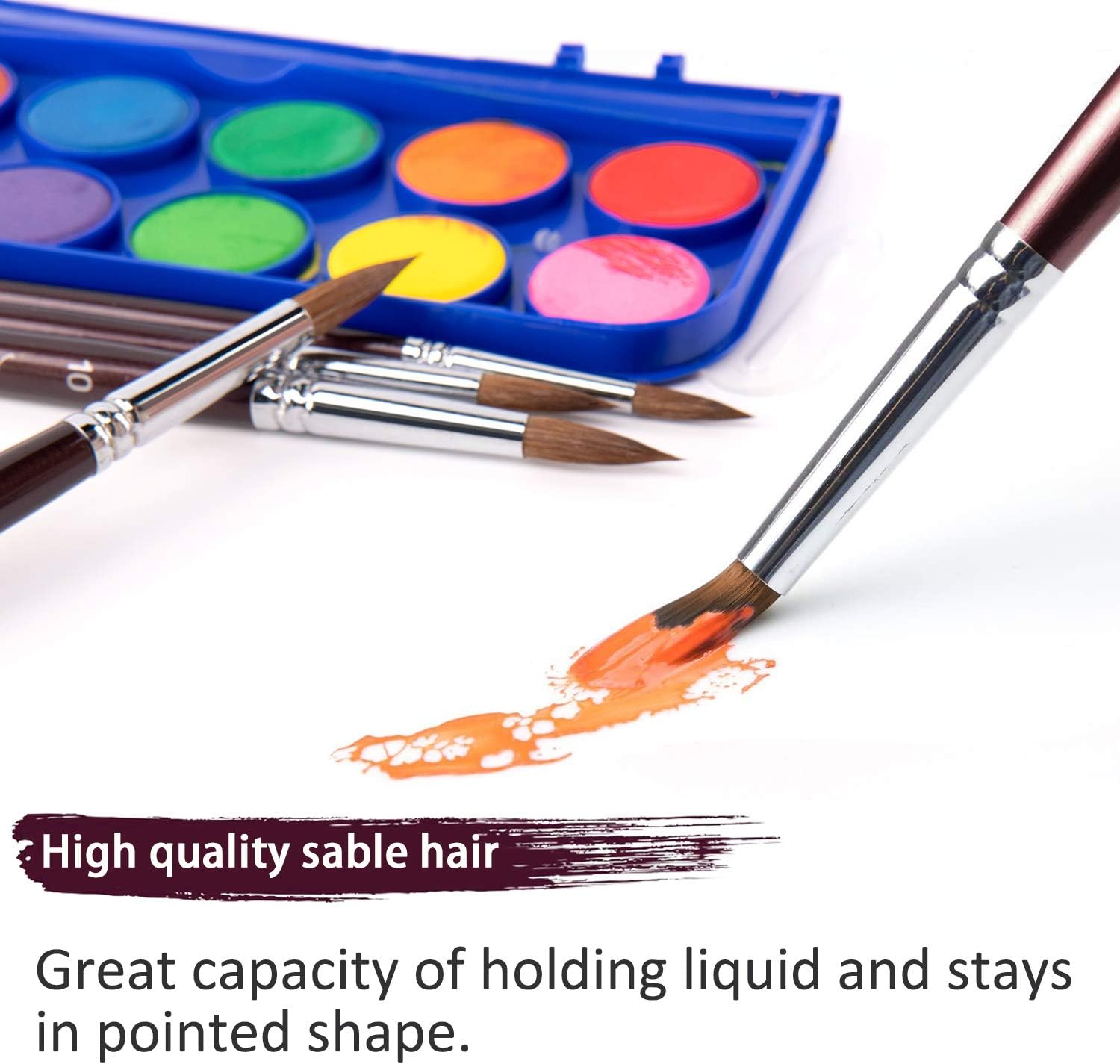
If you’ve ever stood in a craft-supply aisle — or scrolled through a retail listing at 11 p.m. — staring at a twelve-brush set priced at $18.99 and wondered whether it’s a steal or a trap, you’re in exactly the right place. Watercolor brushes are the tools that carry pigment suspended in water across paper, and the quality of that transfer — how much water the brush holds, how crisply the tip points, how evenly it releases — shapes almost everything about the painting experience. At the premium end, brushes made from kolinsky sable (a specific type of weasel fur prized for its spring and water-holding capacity) can run $40 to $200 per brush. But there’s a wide middle ground between those and the truly disposable craft-store throwaway, and that’s what this guide is about. We’re going to walk through what you can realistically expect from a full set under $30, where manufacturers cut corners to hit that price, and which specific value windows are genuinely worth stepping into.
The answer isn’t “all cheap brushes are bad” — it’s more interesting than that.
| EDITOR'S PICK[Rembrandt Series I - 6pc Travel…](https://www.amazon.com/dp/B0CNNM67SG?tag=greenflower20-20) | Mid-tier[Watercolor Brushes Professional](https://www.amazon.com/dp/B09SFYRMKP?tag=greenflower20-20) | Budget pick[Sable Watercolor Brushes](https://www.amazon.com/dp/B08CMKRM4B?tag=greenflower20-20) | |
|---|---|---|---|
| Count | 6 | 8 | 9 |
| Hair type | Kolinsky Sable | Sable | Sable |
| Shape variety | — | Flat, Round, Cat's Tongue | Round Pointed, Mop |
| Travel case | ✓ | — | — |
| Suitable for | Watercolor, Gouache, Oil | Watercolor, Acrylic, Gouache | Watercolor, Gouache, Acrylic |
| Price | $20.00 | $17.99 | $15.99 |
| See on Amazon → | See on Amazon → | See on Amazon → |
What “Mid-Market” Actually Means at This Price Point
Let’s be precise about what we’re evaluating. A set under $30 in 2026 typically lands in one of three construction categories:
- Synthetic nylon or Taklon fiber — the most common in this tier. Taklon is a fine-diameter polyester filament engineered to mimic natural hair. It’s cruelty-free, consistent, and has improved dramatically over the past decade.
- Blended fiber — synthetic core mixed with a small percentage of natural hair (often squirrel or pony) to improve snap and water retention without driving the price to kolinsky territory.
- “Natural hair” budget brushes — pony, goat, or ox hair. Less spring than sable, but genuine natural fiber at an accessible price.
What you will not find in a legitimate set under $30 is kolinsky sable. That’s not a knock on the category — it’s just physics and economics. Per Jackson’s Art’s overview of brush materials, kolinsky hair’s hollow shaft structure is what creates its legendary snap (the ability to spring back to a point after a stroke), and that property cannot be replicated at this price in a full set. Knowing that going in resets expectations correctly.
By the numbers:
| Fiber type | Snap | Water retention | Typical price per brush |
|---|---|---|---|
| Kolinsky sable | Excellent | Excellent | $40–$200+ |
| Synthetic Taklon (quality) | Good | Moderate | $3–$12 |
| Blended (synth + squirrel) | Good | Good | $5–$15 |
| Pony / goat hair | Low | Good | $2–$8 |
That middle two rows are where the under-$30 set lives — and “good” is not “bad.” It’s a real category with legitimate use cases.
Where Value Actually Lives: The Genuine Wins
Flat and wash brushes punch above their weight
Here’s the structural insight that most buyers miss: snap matters most for round brushes doing detail work. For flat brushes, mop washes, and wide strokes, what you actually need is fiber that holds a high water load and releases it evenly. Synthetic Taklon does this well. Reviewers at Wirecutter, in their assessment of beginner-to-intermediate watercolor tools, consistently note that flat and hake-style wash brushes are the category least penalized by synthetic construction — the geometry of the flat ferrule (the metal band that holds the fibers to the handle) compensates for some of the snap deficit.
Sets from brands like Princeton Neptune, Grumbacher Academy, and Royal & Langnickel’s Zen series regularly appear in reader surveys at Artists Network as overperformers in the flat-wash category. Owners report that the fiber holds up well to repeated wetting and drying, and that the handles — typically lacquered wood — don’t swell or crack under studio-use conditions.
The practical upshot: if you’re buying a sub-$30 set primarily for loose, expressive work — backgrounds, washes, large-scale studies — you’re getting very close to what you need.
Handle and ferrule construction is often legitimate
One underappreciated fact about mid-market sets: the handles and ferrules (the metal collars) are frequently manufactured in the same facilities as higher-end brushes. The fiber is where the cost is cut, not always the hardware. Jackson’s Art’s materials guide notes that ferrule crimping and handle-to-ferrule adhesion failures are less common in sets from established brands than in true no-name discount sets — and mid-market branded sets (Princeton, Grumbacher, Da Vinci’s Casaneo line at the lower end) carry that reliability forward.
If you’re evaluating a set and the ferrules look stamped rather than seamless, or the handles feel hollow and lightweight, that’s a more reliable red flag than fiber type alone.
Student and practice use is a legitimate, non-embarrassing use case
The Artist’s Magazine’s reader survey data consistently shows that working watercolorists maintain a tiered brush wardrobe: premium rounds for finished work, mid-market sets for studies, color-mixing tests, and techniques exploration. This is not a poverty workaround — it’s a professional habit. Putting a $150 Series 7 round through repeated cadmium pigment experiments you might abandon is a real cost. A $25 set absorbs that wear without the emotional weight.
Artists Network’s buying guide makes this point directly: the “practice brush” category is real, and a mid-market set with good wash brushes and a few reliable flats serves it well.
Where It Doesn’t Live: The Real Limitations
Fine rounds are the weakest link
This is the honest part. In aggregated reviews across Artists Network and The Artist’s Magazine, the consistent pattern in under-$30 sets is that fine-point rounds — size 0, 1, and 2 brushes — underperform in ways that actively interfere with detailed watercolor technique. The issue is tip retention: synthetic fibers under a certain quality threshold splay or hook after a few sessions, and the result is a brush that simply cannot hold a point well enough for controlled line work, glazing fine detail, or wet-on-wet control in small passages.
This isn’t brand-dependent. It’s material physics. The hollow kolinsky shaft that creates snap simply cannot be replicated at the manufacturing cost that keeps a twelve-brush set under $30. Reviewers keep coming back to this limitation regardless of brand.
The trade-off, put plainly: if detail work is your primary need, a sub-$30 full set is not the right purchase. You’d get more value buying two or three quality single brushes — even mid-range ones — than an entire set that fails at the task you need most.
”Natural hair” claims in this tier require scrutiny
Some sets in this price range are marketed as “natural hair” without specifying the fiber. Per Jackson’s Art’s overview, this often means pony hair or coarse goat hair — both genuine natural fibers, but with significantly less spring than squirrel or sable. Pony and goat brushes hold water well but deliver slow, low-snap strokes that are difficult to control for anything beyond wide coverage. This isn’t fraud, exactly, but the “natural” label carries an implied quality association that doesn’t always transfer at this price.
If a set under $30 claims “natural hair” and doesn’t specify the animal source, treat it as an unknown — it’s likely pony or goat unless otherwise stated.
Set math is often unfavorable for specialists
A twelve-brush set for $22 sounds like exceptional value until you inventory what you’re actually receiving. Typical configuration: three or four sizes of round, two or three flats, a fan brush (rarely used in watercolor), a liner or rigger, and a couple of sizes that duplicate what you already own. The useful-brush count in most mid-market sets is five to seven out of twelve. Per Artists Network’s brush guide, painters report that set purchases consistently over-deliver on brush count and under-deliver on the specific sizes they actually use.
The counterargument: if you’re genuinely building out a wardrobe from scratch with no existing brushes, a set can be a reasonable entry point — with the expectation that you’ll supplement the rounds within a year.
The Specific Value Windows Worth Targeting
Given the above, here’s where the under-$30 category earns its place:
Best use case: wash and flat coverage Sets anchored around larger flat and oval wash brushes — rather than round-heavy configurations — consistently receive better reviews. Look for sets that include at least one wide flat (1-inch or larger) and a round no smaller than size 6 as the “fine” option. This configuration plays to synthetic fiber’s strengths.
Best value move: targeted single-brush purchase within a set’s range Several brands — Princeton Neptune and Grumbacher Academy among them — sell individual brushes from the same lines as their sets. If a set costs $25 and you can identify the two brushes you’d actually use, buying those two singles for $6–9 each is frequently the better math.
Best set brands in aggregated reviews Across reviews synthesized by Artists Network, Jackson’s Art blog coverage, and reader surveys in The Artist’s Magazine, Princeton Neptune’s synthetic squirrel blend consistently earns praise for water retention above what its price suggests. Grumbacher Academy rounds get noted for ferrule durability. Royal & Langnickel’s Zen series is cited for handle comfort in longer sessions. No set in this tier earns universal praise — the tip-retention limitation shows up in every brand’s small rounds — but these names appear more often in “would buy again” language than in “avoid” language.
The If/Then Decision Rule
Here’s the frame that makes this purchase decision clean:
If your primary work is washes, loose studies, or experimental technique practice — a mid-market set under $30 is a legitimate, professional-grade choice for that specific task. Buy the set. Supplement with one or two quality rounds (Princeton Velvetouch or Escoda Versatil singles) for detail passages.
If you need reliable fine-point rounds for finished work — skip the set entirely. Spend the same $25–30 on two quality mid-range single rounds. You’ll have fewer brushes and dramatically more usable tools.
If you’re building from zero and watercolor is new to you — a set is a reasonable entry point, with the explicit expectation that it’s a six-to-twelve month bridge while you figure out which brush sizes you actually reach for. The Wirecutter guide’s recommendation to start broad and narrow down is well-founded here.
If you already own a premium round or two — don’t let a set’s wash brushes go to waste. The flat and mop brushes in mid-market sets are legitimately good. Buying a set for its flats while you already own good rounds is sound wardrobe strategy, not a step down.
The under-$30 tier is real value — it’s just concentrated in specific brush types that most product listings don’t emphasize. Now you know where to look.