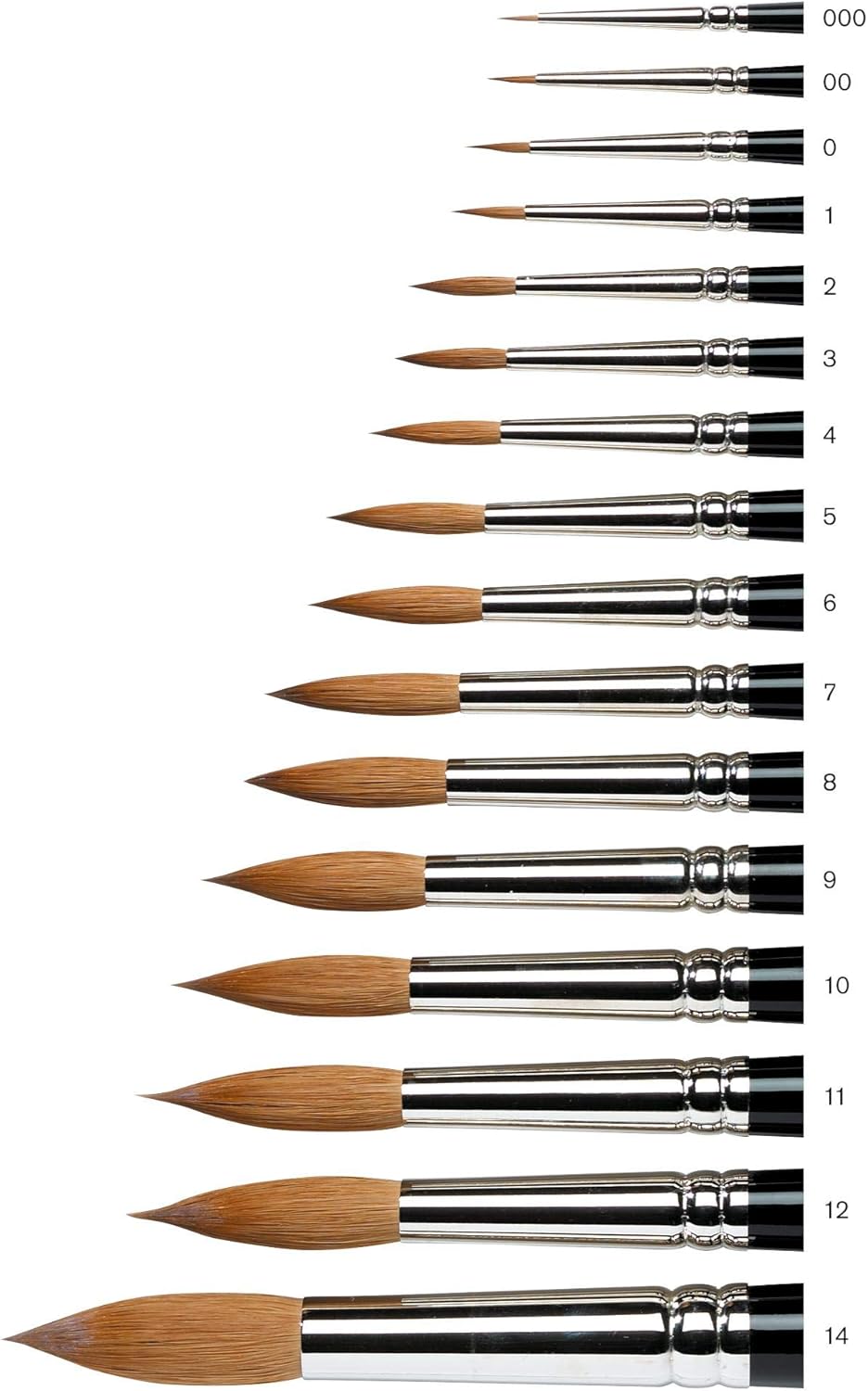
If you’ve started looking seriously at watercolor brushes, you’ve probably run into the Winsor & Newton Series 7 and immediately done a double-take at the price tag. A single brush — one brush — can run $40 for a small size, $90+ for a mid-range size 8, and well over $150 for the larger rounds. The Series 7 is made from kolinsky sable, which means the hair comes from the tail of the Siberian kolinsky (a weasel-like animal native to cold-climate Russia and China). Kolinsky sable has a reputation as the gold standard for watercolor brushes because of two properties that are genuinely hard to replicate: the hairs taper to a very fine point on their own, and each hair has a natural spring — a snap-back quality — that synthetic fibers have spent decades trying to match. So the question isn’t whether these brushes are good. It’s whether they’re the right investment for you, right now, given where you are in your practice and what else that money could do.
That’s what this guide is actually about. We’ll break down exactly what the price is buying you, where the Series 7 earns its reputation and where it doesn’t, how it compares against its closest rivals at similar price points, and close with a clear decision framework so you can stop second-guessing and pull the trigger — or confidently walk away.
What the Price Is Actually Buying You
The Series 7 has been manufactured since 1866, originally made for Queen Victoria, and Winsor & Newton’s marketing leans heavily on that heritage. Heritage is real, but it isn’t what you’re paying for when you buy one of these brushes today. Here’s what actually goes into the price.
The hair itself is expensive and increasingly scarce. Kolinsky sable sourcing has become genuinely difficult. Export controls from Russia following 2022 sanctions disrupted supply chains for the entire premium brush industry, and as of mid-2026, kolinsky availability remains constrained — a point Jackson’s Art Supplies covered in detail in their kolinsky sable guide, noting that multiple manufacturers have faced extended lead times and some size ranges have seen limited stock across major retailers. The raw material cost is baked into every Series 7 price you see.
Sorting and hand-tying labor. Kolinsky hairs are sorted by hand for length, curvature, and taper. Only a small percentage of hairs from each tail are suitable for fine brush-making. The Series 7 is still hand-tied and hand-formed at Winsor & Newton’s Lowestoft facility, which means skilled labor in a country with real labor costs. This is a meaningful distinction from less expensive kolinsky brushes assembled in lower-wage markets — though that’s a trade-off, not a moral judgment.
Performance properties that are genuinely measurable. Winsor & Newton’s own specification documentation describes the Series 7’s performance in terms of snap (return to point after stroke), belly capacity (how much water and pigment the brush holds in its midsection), and tip integrity (how precisely the point holds under pressure). Across aggregated reviews on platforms like Jackson’s Art Blog and Artists Network, the consistent pattern from working painters is that the Series 7 does three things very well: it holds a remarkable amount of paint for a fine-tipped brush, it springs back to point reliably, and the tip stays crisp through long painting sessions without splaying. These aren’t marketing claims — they’re what owners come back to again and again.
By the Numbers
| Size | Approximate Retail (2026) | Tip Diameter (manufacturer spec) | Best-Fit Use Case |
|---|---|---|---|
| 1 | $38–$45 | ~0.5mm | Fine detail, glazing lines |
| 4 | $55–$70 | ~2mm | Detail work, small washes |
| 7 | $90–$110 | ~4mm | Versatile all-rounder |
| 10 | $140–$165 | ~6mm | Larger washes, portraiture |
| 14 | $190–$220+ | ~8mm | Landscape washes, broad coverage |
Retail prices observed across major art retailers, May 2026. Price volatility of 20–30% between retailers and sale events is common — see our price-alert signup for tracking.
Where the Series 7 Earns Its Reputation — and Where It Doesn’t
Let’s be honest about both sides, because neither is the full picture.
Where it genuinely excels:
The belly-to-tip ratio on the Series 7 rounds is the thing most professional watercolorists cite as irreplaceable. The Artist’s Magazine’s watercolor brush feature (2025) notes that experienced painters frequently describe the experience of a well-loaded Series 7 as “painting from a reservoir” — the brush holds enough pigment to complete substantial passages without reloading, while the tip still delivers enough precision for edge control. For wet-into-wet techniques, transparent layering (glazing), or portrait work where you’re constantly toggling between broad washes and fine detail without switching brushes, this specific combination is hard to find elsewhere at the same level of consistency.
Longevity is also real, with proper care. Owners working in professional environments consistently report Series 7 brushes lasting five to ten years with standard maintenance — rinsing immediately after use, reshaping the tip, and storing horizontally or tip-up. The cost-per-year math, spread over a decade, looks more reasonable than the sticker price implies.
Where it doesn’t justify the premium:
For students or intermediate painters still building stroke control, a brush this responsive can actually work against you. The sensitivity of a fine kolinsky tip means it reads every hesitation and pressure inconsistency in your hand. Artists Network’s piece on brush hair types makes the point plainly: a brush that performs at the ceiling of your current technique doesn’t improve your work — it just makes your current weaknesses more visible. If you’re still developing a consistent hand, a mid-range synthetic or synthetic-sable blend may serve you better right now.
The Series 7 is also optimized for traditional watercolor — transparent pigment on paper with water as the primary medium. If you’re working heavily with gouache, watercolor with additives (ox gall, flow improver), or using your watercolor brushes for ink work, the kolinsky hair will wear faster and the investment calculus shifts accordingly. Jackson’s Art Blog’s “Are Expensive Brushes Worth It?” piece addresses this directly, noting that medium compatibility matters as much as technique level when evaluating premium natural-hair brushes.
How It Compares to the Main Alternatives
The Series 7 doesn’t exist in a vacuum. At similar or overlapping price points, you’re also looking at:
Da Vinci Maestro Series 10 (kolinsky sable): Reviewers at Jackson’s Art Supplies consistently place the Da Vinci Maestro as the closest direct competitor. The consensus across aggregated owner reviews is that the Maestro tip is slightly softer in snap — some painters prefer this, especially for wet-into-wet work where aggressive spring can disturb wet layers. The Series 7 is generally regarded as snappier and more precise for fine-line control. At comparable sizes, prices run within 10–20% of each other as of mid-2026, making this a genuine preference question rather than a value question.
Escoda Reserva (kolinsky-tajmyr sable blend): Escoda uses kolinsky mixed with tajmyr sable (a different subspecies) in their Reserva line, which is priced slightly below the Series 7 in most size ranges. The Artist’s Magazine has noted the Reserva as a strong option for painters who want natural sable performance with a slightly more forgiving tip — a meaningful trade-off for intermediate painters making the jump from synthetic for the first time.
High-quality synthetic rounds (Princeton Neptune, Escoda Synthetic Sable, Silver Black Velvet): Synthetic technology has improved dramatically. For painters not yet committed to the kolinsky tier, these brushes run $10–$25 each, and across review aggregations, they handle washes and soft wet-into-wet work very well. Where they consistently fall short versus natural sable is in snap and fine-tip longevity — synthetics tend to splay or lose point integrity faster under sustained heavy use. But for building technique at the intermediate level, the performance gap is narrower than the price gap.
The Ethics and Regulatory Layer (Don’t Skip This)
Kolinsky sourcing sits in an ethically and legally complicated space that any informed buyer should understand before purchasing. The Siberian kolinsky is not currently listed under CITES (the Convention on International Trade in Endangered Species) as a protected species, which is why trade in kolinsky hair products remains legal — but the regulatory environment has been shifting. Russia’s export restrictions since 2022 have reduced legal supply, which has also increased the prevalence of counterfeit or mislabeled brushes in gray markets.
This matters practically: brushes sold as “kolinsky sable” on third-party marketplace listings at suspiciously low prices are frequently not kolinsky at all — they may be squirrel hair, synthetic, or mixed fibers, sometimes with misleading labeling. We track counterfeit activity in the premium brush market as part of our ongoing coverage; the Series 7 and similar premium lines are among the most frequently counterfeited products in the category. Buying from authorized retailers (major art supply chains, Winsor & Newton’s direct channel, or reputable specialist retailers) is the only reliable way to ensure you’re getting what you’re paying for.
The Decision Framework: If X, Then Y
Here’s how to use everything above to make a clean decision:
If you’re painting regularly (3+ sessions per week), working in transparent watercolor on paper, and have reached the point where brush performance is the clearest remaining variable in your work — buy a Series 7 size 7 or 8 as your first entry point. This is the size where the belly-to-tip ratio shows most clearly, and it’s versatile enough to validate whether the investment matches your practice before committing to a full set.
If you’re an intermediate painter still building consistent pressure control and stroke vocabulary — start with a Da Vinci Maestro or Escoda Reserva instead. The performance gap between these and the Series 7 is real but narrow at this stage, and you’ll get more signal from your technique development than from the brush difference.
If you’re working in mixed media, gouache, or ink alongside watercolor — factor medium wear into the math. The cost-per-use advantage of kolinsky compresses significantly if you’re using the brush in conditions that accelerate hair wear. A premium synthetic or synthetic-sable blend may be smarter capital allocation.
If the price you’re seeing seems too good — it probably is. Any Series 7 equivalent listed significantly below the price ranges in the table above on a third-party marketplace is a red flag worth taking seriously. The raw material alone makes deep discounting implausible from legitimate sources.
The Series 7 is not the right brush for every painter. But for the painter it’s right for, it’s one of the most defensible premium investments in the craft. Know which one you are, and the decision gets simple.